It all started on my first trip to Manila… somebody there was a big proponent of coconut oil for all sorts of health and beauty reasons, and specifically oil pulling (and be sure to see the voluminous comments attached to that link… it’s a subject that inflames passion even as it strengthens your gums), where you use the oil kind of like viscous mouthwash for beautiful teeth. Coconut oil enthusiasts are true believers, like apple cider vinegar people or brewer’s yeast aficionados. And it’s funny to me: there’s not much proof for any of these things, but the evangelists always look so radiant: I wonder if health food evangelism itself might be the greatest cure-all.
Anyway, I came home with a little bottle of coconut oil, and I’ll admit that I didn’t take to using it, despite its many wondrous properties. The bottle has kicked around the pantry shelf ever since, and has become a kind of joke… one answer to “What’ll we do about _____” is always “Coconut oil!!”
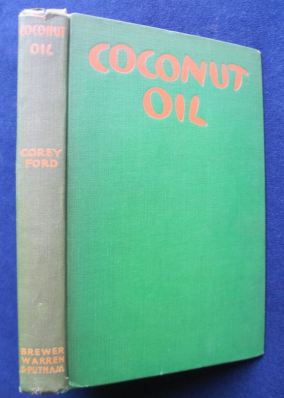
So, when I chanced upon a copy of a book called Coconut Oil in the antique store the other day, I had to get it. And in doing so, discovered a rabbit hole (and in case one rabbit hole isn’t enough, here’s a detour…).
Coconut Oil, from 1931, is the story of June Triplett’s journey to Africa, as recounted to author Corey Ford. And so, who’s Corey Ford? A wit, a wag, and a confirmed bachelor (as one might have said in those days). All told, he published about 30 books. He hung out a bit with the Algonquin Round Table gang, an amazing bunch some of whose members I’m familiar with, but whose antics and collaboration I didn’t know anything about. And these days the Algonquin is a Marriott, so I’ve got frequent flyer status! He wrote for the New Yorker among others, and is even credited with naming the foppish New Yorker logo guy. Later in life Mr. Ford published a much-loved and long-running column in Field and Stream, creating an unlikely juxtaposition of metropolitan urbanity and outdoorsiness. At some point, he settled in near the Dartmouth campus, where he became a sort of patron to the rugby club (because who doesn’t like rugby players?). When he died, he even left them his house, and the Dartmouth rugby clubhouse bears his name to this day. All in all, someone I would really have wanted to meet. That said, I wonder if all that banter and cleverness would grow tiresome after while… I can keep up with that sort of thing for a while, but it’s draining.
Back into the rabbit hole. June Triplett, the fictional heroine of Coconut Oil, is actually making her second appearance in this book. She first appeared in Salt Water Taffy: The Incredible Autobiography of Captain Triplett’s Seafaring Daughter. Oh, really? And why would witty Mr. Ford write a book like that? Well, because of Cradle of the Deep, that’s why.
Cradle of the Deep, from 1927, was the story of Joan Lowell’s remarkable upbringing from infancy through age 17 aboard her father’s ship. She sailed the seven seas, surrounded entirely by the all-male crew, figured out the facts of life by peering inside a pregnant shark, harpooned a whale all by herself, and finally swam to safety after her ship sank three miles off the coast of Australia. It was a huge bestseller, that is, until the San Francisco Chronicle published interviews with her childhood neighbors in Berkeley, who asserted that Joan grew up pretty much like everybody else. It turns out that the practice of memoir fabrication didn’t start with Running with Scissors or Eleven Gallons of Tea.
And so, the literary public was ripe for a parody. Corey Ford jumped, and Salt Water Taffy came out just a few months after the scandal broke. Another round of champagne!
Back to Coconut Oil… another literary and cinematic trend of the time centered on deepest darkest Africa. A number of far-fetched safari memoirs came out and were adapted for the screen. One of the most famous was Trader Horn, which I actually bought and sat through. It’s terrible!!! Moviemaking has come a long way since then (although Edwina Booth, who plays the White Goddess and whose health and career were seriously damaged during the location filming, certainly was easy on the eyes and posed a challenge to my internal Mormon-girl stereotype). But it’s terrible in a way that does indeed scream out for parody. And so June Triplett sets off from New York on an old high-wheel bike rigged to fly with a patio umbrella, with a professional stowaway and old Professor Britches, for a series of madcap adventures involving large animals, cannibals, Pygmies, and of course the discovery of a petulant and underappreciated White Goddess, just like in Trader Horn. As this review says, it’s hard to be consistently funny for 200+ pages, but the obviously-fake pictures are pretty entertaining, even though we would use a more sensitive technique to portray interactions between colonialist explorers and indigenous people these days.
So, back out of the rabbit hole unscathed. All in all, a good trip. Two books skimmed but not really read, a bad-but-you-can’t-take-your-eyes-off-it movie watched, and a new sliver of Wikipedia surfed. I’ve got another story that is probably more interesting to me than to than anyone I’ll ever tell it to, a few new spots to stop by if I’m ever in the area, and a few more connections to track down next time I am hunting for connections to track down (for instance, could any of the Algonquins, who spent a lot of time in VT and NH, have visited Madame Sherrie? seems plausible… they would likely have known each other at least casually through theatrical connections, and the Castle would have made a nice stopping point en route further north).
 Brattleboro Adventure – the Auckland Edition
Leave a comment